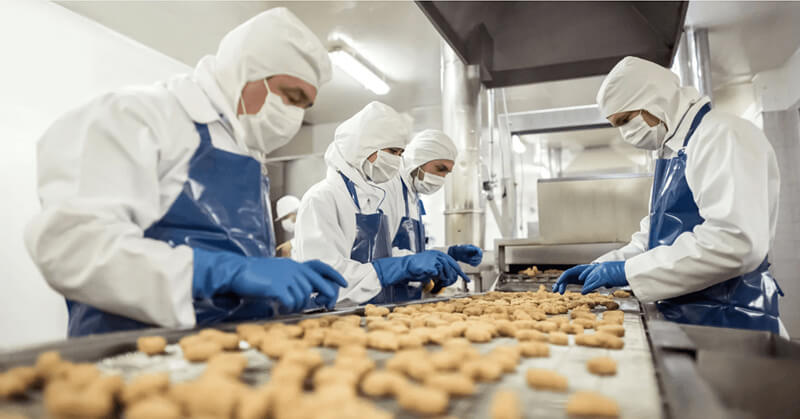
Your plant makes human food. Six months ago, you added a pet treat line. Now your lawyer says you're "probably fine" under your existing Part 117 food safety plan.
Can a dual-use food facility run one FSMA program for human and animal food? Yes. Under 21 CFR 507.1(d), a facility subject to both Part 117 and Part 507 can follow Part 117 for its animal food. The catch: if you follow Part 117's preventive controls for animal food, your hazard analysis has to evaluate animal food hazards, and your plan has to control any that need a preventive control.
Whether you're "probably fine" depends on what that hazard analysis actually says. Here's how to check.
TL;DR
- One program can cover both. 21 CFR 507.1(d) lets a facility subject to both Part 117 and Part 507 follow Part 117 for its animal food.
- The condition: if you use Part 117's preventive controls for animal food, your hazard analysis has to evaluate animal food hazards, and your plan has to control any that need a preventive control.
- By-products sent to feed without further processing are limited to the holding and distribution requirements in 507.28 and 117.95 under 507.12. FDA also has an enforcement discretion policy for a short list of limited steps.
- Evaluate nutrient imbalances, mycotoxins and Salmonella, and update your allergen changeover protocol. Allergen controls are mandatory where cross-contact needs a preventive control. Swab testing is one optional way to verify them.
- Keep your records connected, so you can trace a monitoring result to its corrective action and verification on any line.
What is a dual-use food facility?
A dual-use food facility makes both human food and animal food under the same roof. Common examples:
- Pet food and treat makers that co-pack human snack items
- Meat and poultry processors that send trim or organ by-products to animal feed, unless USDA FSIS regulates the whole facility (those plants are not required to register with FDA, so Part 507 does not apply to them)
- Grain and oilseed plants that make human flour and animal feed ingredients on shared equipment
- Co-manufacturers that added a pet food line for a retail customer
That last case comes up often. A contract manufacturer making pet food for a grocery retailer faces the same FDA requirements as any other dual-use plant, plus the customer's own on top.
The regulatory question is which FSMA rules apply to which activities, and whether you can manage both under one food safety program.
What's the difference between FSMA Part 117 and Part 507?
21 CFR Part 117 covers human food. 21 CFR Part 507 covers animal food. The two rules are built the same way: CGMPs, then a written food safety plan with a hazard analysis, preventive controls, monitoring, corrective actions, verification and a PCQI. The CGMPs run in parallel but aren't identical, and the hazards differ.
| Element |
Part 117 (human food) |
Part 507 (animal food) |
| Scope |
Facilities that make, process, pack or hold human food |
Facilities that make, process, pack or hold animal food |
|
CGMPs |
Subpart B |
Subpart B |
|
Hazard analysis and preventive controls |
Subpart C |
Subpart C |
|
PCQI required |
Yes | Yes |
|
Supply-chain program |
Subpart G |
Subpart E |
|
Records |
Subpart F |
Subpart F |
|
Qualified facilities |
Modified requirements (117.201) |
Modified requirements (507.7) |
Check your exemptions before assuming the full rule applies. 21 CFR 507.5 lists who is exempt from all or part of Part 507, and 21 CFR 117.5 does the same for Part 117. Two examples: establishments not required to register with FDA are outside Part 507 entirely, and qualified facilities follow modified requirements (117.201 for human food, 507.7 for animal food) instead of the full preventive controls subparts. Read the sections against your own operation.
Some obligations sit outside your food safety plan, and each one applies only if you meet its scope. All three are in 21 CFR Part 1. Facility registration (Subpart H) applies to most facilities that make, process, pack or hold food for US consumption, with exemptions such as facilities regulated exclusively by USDA. The Foreign Supplier Verification Program (Subpart L) applies if you import food, including animal food ingredients. The sanitary transportation rule (Subpart O) applies if you ship, load, receive or carry food by motor or rail vehicle, and it has its own exemptions. Check each one against your operation.
Can one food safety plan cover both human and animal food?
Yes. 21 CFR 507.1(d) gives a facility subject to both rules two options:
- CGMPs: follow Part 117 Subpart B for your animal food instead of Part 507 Subpart B.
- Preventive controls: follow Part 117 Subpart C for your animal food instead of Part 507 Subpart C, "provided the food safety plan also addresses hazards for the animal food, if applicable, that require a preventive control."
That condition is where plans get into trouble. A Part 117 plan written for your human food lines may never have considered animal food at all. If your hazard analysis doesn't evaluate the animal food you make, it can't show that you identified, or ruled out, the hazards that need a preventive control.
The rule doesn't require a long list of new controls. If your PCQI evaluates the animal food and documents why no hazard needs a preventive control, that can be a valid conclusion. What won't hold up is a plan that never asked the question.
A quick self-check:
- Does your hazard analysis name your pet food or animal food lines and products?
- Does it evaluate hazards specific to animal food, such as the ones below?
- For each hazard, does it document whether a preventive control is needed, and why?
If any answer is no, update the plan before your next inspection. For more on how a FSMA food safety plan differs from HACCP, see food safety plan vs. HACCP differences.
What if you only send by-products to animal feed?
If your plant sends by-products such as trim, spent grain or vegetable culls to animal feed without further processing, the burden is much lighter.
Under 21 CFR 507.12, Part 507 is limited to the holding and distribution requirements in 507.28 and 117.95 for those by-products when two conditions are met:
- Your facility is subject to and complies with the Part 117 CGMPs (Subpart B) and other applicable human food safety requirements.
- You don't further manufacture or process the by-product for animal food.
In practice, 507.28 and 117.95 mean protecting by-products from contamination while you hold them, identifying and labeling them by common or usual name, and examining shipping containers and vehicles before use.
The condition that trips people up is further processing. FDA's draft guidance, GFI #239, defines it broadly and says drying, heat treatment, freezing and pelleting are generally further processing. Passive steps, like dewatering by holding by-products in a container with a screened bottom, generally are not. Once you further process a by-product, the 507.12 exemption no longer applies to it and Part 507 does. GFI #239 is still draft guidance, so read it closely if your operation is near that line.
FDA also has a separate enforcement discretion policy for a few limited steps. In its March 2022 enforcement policy guidance, FDA says it intends to use enforcement discretion on the Part 507 preventive controls requirements for human food facilities that meet the 507.12 conditions and, after separating by-products from the human food, only do the following:
- Drying or dehydrating, evaporating, pressing, chopping and similar steps that reduce weight, bulk or volume
- Mixing, centrifuging and similar steps that combine ingredients or separate components, such as water and solids
Those steps can't be performed to prevent or significantly minimize animal food hazards, and they can't introduce new ones. The policy is narrow: it doesn't cover heating or cooling to address pathogens, pelleting, extruding or formulating, or a facility that does other processing on its by-products. It is also enforcement discretion, not an exemption, so FDA can change it and it doesn't change your registration obligations. Document why each step you perform fits.
Meat and poultry trim is a special case. If USDA FSIS regulates your whole facility, you are not required to register with FDA (21 CFR 1.226), and Part 507 does not apply to you, though FDA's adulteration authority can still reach the by-products. If you also make FDA-regulated food, or you process by-products yourself, confirm with your FSQA lead which agency covers each activity.
Which animal food hazards does your human food plan miss?
This is where dual-use programs often have a gap. Listing the hazards isn't enough. Your PCQI needs to work through each one: is it reasonably foreseeable, how severe is it, how likely is it, and does it need a preventive control? FDA's final guidance, GFI #245 (July 2022), includes hazard information you can use for that evaluation.
Nutrient imbalances. Animal diets are formulated to specific nutrient profiles. Too much selenium, vitamin D or copper can be toxic to livestock or pets, and too little of an essential nutrient can cause illness. If you add vitamin or mineral premixes, ask whether this hazard needs a preventive control. It often will, but the answer depends on your formulation, the gap between the required and toxic level for your species, and how reliably your process controls the addition. Two examples of how the control can differ:
- Fixed formula, supplier COA with nutrient guarantees: a COA can be one part of supplier verification, but your plan has to show it is enough for that hazard. Your supply-chain program decides what else you need, such as periodic testing, audits or review of the supplier's records.
- Formulation varies by batch: an in-process control, such as verified weighing and batching, may be the better fit, because a supplier COA can't confirm what goes into each of your batches.
Mycotoxins. FDA sets aflatoxin action levels for animal food in CPG Sec. 683.100, and they vary by species and life stage, from 20 ppb up to 300 ppb for finishing beef cattle. FDA also publishes advisory levels for deoxynivalenol (DON). If your grain-based ingredients could carry mycotoxins, your hazard analysis has to decide whether supplier controls are enough or whether you need incoming testing. If you rely on supplier controls alone, your plan should show the testing data that supports them.
Salmonella in finished pet food. Treat this as a human health hazard as well as an animal health one. FDA's CPG Sec. 690.800 says FDA considers pet food contaminated with any Salmonella adulterated when no later commercial step will kill it, in part because people handle pet food directly. The CPG is nonbinding guidance for FDA staff. It shows how FDA approaches enforcement and doesn't replace your own hazard analysis, but it raises the severity in that analysis and makes a preventive control likely for any pet food with no later kill step. If you validated your kill step for the human food line but not the pet food line, an investigator could ask for the same support on the pet food line. For more on structuring these programs, see HACCP compliance and food safety allergen programs.
How do you prevent cross-contact between human and pet food lines?
Start with allergens. FDA doesn't require allergen labeling on animal food, so pet food formulas can contain wheat, soy, fish or peanuts with no allergen declaration. On a shared line, the allergen risk runs mainly from pet food into human food. Part 117 requires food allergen controls where cross-contact is a hazard that needs a preventive control (21 CFR 117.135(c)(2)), so your human food allergen control plan has to account for pet food ingredients explicitly. Otherwise you're relying on controls that weren't designed for them.
Allergen controls are mandatory in that situation. How you verify them is your PCQI's call. Swab testing is one verification method, and 21 CFR 117.165 treats product testing and environmental monitoring as activities to use as appropriate to your facility, food and control. Visual inspection or other documented verification can fill the same role. If your plan does specify swabs, follow it and record the results.
Pathogens are different: they move in both directions. Raw animal-derived pet food ingredients can bring Salmonella onto a human food line, and a human food line can contaminate pet food that has no later kill step.
Here is one documented changeover after a pet food run containing fish meal, before the line goes back to human food. Adjust the verification step to match your plan:
- Clean and sanitize to the written SOP.
- Verify the cleaning the way your plan specifies, such as visual inspection, allergen swabs or both, and log each result with a timestamp.
- Review results against your acceptance criteria before anyone signs off line clearance.
- Log the line clearance sign-off in the monitoring record with batch and shift.
- Link the first human food lot to that clearance record. If a later test finds residue, you can trace it to the exact changeover.
Without that chain, a request to see the corrective action for a monitoring deviation turns into a binder search.
Timing matters too. Freshpet, a pet food manufacturer and SafetyChain customer, runs a 24/7 operation with short-shelf-life fresh products and relies on real-time data to act quickly. The same urgency applies on a dual-use line, where a missed allergen result can reach the next human food run before anyone sees it.
If you're a co-manufacturer with customer-specific allergen requirements, document this protocol at the SOP level and have it ready for GFSI and retailer audits. A dual-use program that fails a retailer audit is a commercial risk as well as a regulatory one.
Which records should you be ready to show an FDA investigator?
FDA doesn't follow a fixed order. What an investigator asks for depends on the facility, the type of inspection and what turns up along the way. These are the records a dual-use plant should be able to produce quickly, because each one shows whether your single program covers animal food.
The hazard analysis.
A complete analysis isn't enough on its own. It has to show your animal food products. If you use the 507.1(d) single-plan option and the hazard analysis only covers human food, the plan doesn't show that you evaluated animal food hazards.
A complete analysis isn't enough on its own. It has to show your animal food products. If you use the 507.1(d) single-plan option and the hazard analysis only covers human food, the plan doesn't show that you evaluated animal food hazards.
A monitoring record traced to its corrective action.
An investigator may pick a deviation or a random record and follow it through. Suppose the monitoring record is in a binder, the corrective action is in a separate log, and the verification sign-off is somewhere else. Each record may be fine, but without a clear chain from result to corrective action to verification, you can't show that your system works.
An investigator may pick a deviation or a random record and follow it through. Suppose the monitoring record is in a binder, the corrective action is in a separate log, and the verification sign-off is somewhere else. Each record may be fine, but without a clear chain from result to corrective action to verification, you can't show that your system works.
Sokol & Company, a food products supplier and SafetyChain customer, moved from paper-based FSQA records to electronic documentation to keep up with FSMA and stay audit ready. The same approach helps on a dual-use line: when your human food and animal food records live in one system, you can follow any event from result to corrective action to verification without a binder search.
Supplier controls. If one supplier ships an ingredient to both your human food and animal food lines, your supply-chain program needs to account for both uses. A COA that meets your human food spec may not document the mycotoxin testing your animal food hazard analysis relies on. For more, see supplier quality management.
Checklist: building one program for a dual-use plant
Food safety program (PCQI)
- ☐ Check 507.5 to confirm which parts of Part 507 apply to your facility
- ☐ Confirm your hazard analysis names your animal food lines and evaluates animal food hazards
- ☐ Evaluate nutrient imbalances, mycotoxins and Salmonella (including human handling exposure)
- ☐ Document how your PCQI is qualified to evaluate animal food hazards
- ☐ For each animal food hazard, document whether a preventive control is needed, and why
- ☐ Update your allergen control plan for pet food ingredients that carry no allergen declaration
- ☐ Confirm supplier controls cover ingredients used on both human and animal food lines
- ☐ If you send by-products to feed, confirm your steps meet 507.12 or fit FDA's limited-processing enforcement policy, and document why
- ☐ Confirm whether registration, FSVP and sanitary transportation apply to you, and meet each one that does separately from your plan
Plant floor (line supervisors)
- ☐ Allergen changeover SOPs posted and current, with the verification method and acceptance criteria documented
- ☐ Line clearance sign-off linked to the monitoring record for the next production run
- ☐ Corrective action records completed when the deviation happens, not at end of shift
- ☐ Scheduling records show which product ran on which line and when, without a binder search
Frequently asked questions
Yes. Under 21 CFR 507.1(d), a facility subject to both Part 117 and Part 507 can follow Part 117 for its animal food. If you use Part 117's preventive controls, your plan also has to address animal food hazards that require a preventive control. You don't need two separate plans, but your hazard analysis has to name and evaluate your animal food.
21 CFR Part 117 covers human food and Part 507 covers animal food. Both require CGMPs, a written food safety plan with a hazard analysis, preventive controls, monitoring, corrective actions, verification and a PCQI. The CGMPs aren't identical and the hazards differ, so a plan built for human food needs a separate look at animal food hazards.
Only partly. If you send by-products to animal feed without further processing and you meet the Part 117 CGMP and other human food safety requirements, 507.12 limits Part 507 to the holding and distribution requirements in 507.28 and 117.95. FDA also has an enforcement discretion policy for a short list of limited steps, such as drying, chopping or mixing. Heat treatment, pelleting and formulating generally put those by-products under the full rule.
Not if USDA FSIS regulates the whole facility. Those plants aren't required to register with FDA (21 CFR 1.226), so Part 507 doesn't apply to them, though FDA's adulteration authority can still reach their by-products. If you also make FDA-regulated food, or you process by-products into animal food yourself, confirm which agency covers each activity.
Start with nutrient imbalances, mycotoxins and Salmonella, then work through every other hazard that is reasonably foreseeable for your products. For each one, document how severe it is, how likely it is and whether it needs a preventive control. FDA's GFI #245 includes hazard information you can use for that evaluation.
No. Allergen controls are required where cross-contact is a hazard that needs a preventive control (21 CFR 117.135(c)(2)), but swab testing is only one way to verify them. Under 21 CFR 117.165, product testing and environmental monitoring are verification activities you use as appropriate to your facility, food and control. Your PCQI decides whether swabs belong in your plan.
Not in finished pet food that gets no later kill step, in FDA's view. FDA's CPG Sec. 690.800 says FDA considers pet food contaminated with any Salmonella adulterated in that case, in part because people handle pet food directly. The CPG is nonbinding guidance for FDA staff, but it shows how FDA approaches enforcement. Treat Salmonella as a hazard that likely needs a preventive control, and validate your kill step on the pet food line.
Yes, if the facility is subject to Part 507's preventive controls requirements. A PCQI qualifies through training at least equivalent to FDA's recognized standardized curriculum or through job experience (21 CFR 507.53). Part 507 doesn't require a separate animal food PCQI certificate. The FSPCA Preventive Controls for Animal Food course is a common route, and its certificate is one way to document qualification. See FSMA PCQI responsibilities for what the role covers.
Yes. Neither rule prevents one qualified person from overseeing a plan that covers both. If your PCQI trained on human food only, document how they are qualified to evaluate animal food hazards, whether through training, experience or both.
Yes, with documented controls. Shared equipment needs a changeover protocol covering allergens, pathogens and scheduling, and each changeover needs a verifiable record. Your hazard analysis should show which products run on which lines, and your allergen plan has to account for pet food ingredients.
If you're relying on 507.1(d) to cover animal food under your Part 117 plan, the plan has to address animal food hazards that need a preventive control. A plan that never evaluated animal food can't show that. Update your hazard analysis before your next inspection.
See how to run one food safety program across both lines
A dual-use plant can have the right controls and still struggle to prove them. An investigator asks you to trace a monitoring result to its corrective action on a shared line, and the answer is in two binders.
SafetyChain lets you keep one set of monitoring records, corrective actions and supplier controls across your human food and animal food lines. See how it works.