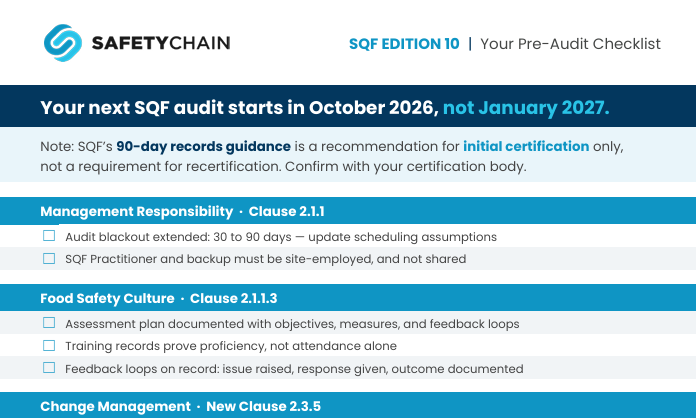
If your team is planning to get serious about SQF Edition 10 compliance in December 2026, you're already behind.
Not because the standard is more complex than expected (though it is). Not because your auditor will show up early. But because of a records requirement that most facilities aren't building their preparation timeline around: SQF mandates a minimum of 90 days of documented records before a site audit is conducted.
Do the math. If your audit is scheduled in early January 2027, auditors will look back to October 2026. That means how your team is documenting food safety activities right now, your supplier approvals, your environmental monitoring records, your change management logs, your food safety culture evidence, is already inside the audit window.
January 2027 isn't your real deadline. October 2026 is.
The 90-day rule, explained
SQF Edition 10 requires a minimum of 90 days of documented records to be available before a site audit. This applies to all activities scheduled to occur at least annually.
This isn't a storage policy. It's a lookback requirement. When an auditor arrives, they're not evaluating what you've prepared for them, they're examining what your facility actually did in the prior 90 days.
There's a second timeline complication worth understanding. Edition 10 requires facilities to be operating under the new standard before audits begin, not just on the day the auditor arrives. The implementation window means your systems need to be functional well ahead of your scheduled audit date, not spun up in the final weeks. (Safe Food Alliance and the Food Manufacturing / Nelson-Jameson analysis \[1\] reinforce this framing, though the official SQFI effective date should be confirmed at sqfi.com before calendaring your compliance milestones.)
Many QA managers are treating January 2027 as a safe planning horizon. The timeline math says otherwise.
Edition 10 won't surface a compliance problem, it will surface a systems problem
The most common response to a standard update is a documentation push: review your SOPs, update your HACCP plans, confirm your supplier approvals are current. That work is necessary. But Edition 10 also introduces requirements that documentation sprints alone can't fix, because they're designed to test whether your systems are sound, not just whether your paperwork is complete.
Consider the new mandatory requirements:
- Food safety culture is now a measurable, auditable requirement. Auditors aren't just reviewing your culture plan, they'll interview personnel and observe day-to-day practices to confirm that documented objectives are actually being followed. (Food Manufacturing / Nelson-Jameson, March 2026)
- Change management (Clause 2.3.5) requires a documented procedure for managing changes to equipment, processes, products, and suppliers, including documented training assessment that verifies employee knowledge and proficiency before changes are implemented. If your change trail lives in email threads or one employee's memory, that's a finding. SafetyChain's CAPA and change management workflows create a timestamped, auditable record of what changed, when, who was trained, and whether proficiency was verified.
- Risk-based environmental monitoring is now mandatory. In Edition 9, a formally documented, risk-based environmental monitoring program tied to hazard analysis wasn't explicitly required. Edition 10 mandates it, and requires records that demonstrate the direct connection between your program design and your food safety plan hazard analysis.
Now ask yourself: if the QA manager or SQF Practitioner who built your current systems left in the next six months, what would your audit look like?
Would an auditor find documented procedures any trained employee could execute and verify? Or would they find records that exist because one person knew to create them, processes that work because one person knows to run them, and culture evidence that depends on one person being present to articulate it?
Edition 10's revised Core Clause scoring makes this question consequential. A minor Core Clause finding now deducts 2 points (double the deduction under Edition 9). A major Core Clause finding deducts 7 points, up from 5. Facilities scoring between 70–79 receive a "Certified with Surveillance" outcome, requiring a 6-month surveillance audit. The margin for gaps in Core Clause areas, supplier approval programs, food safety planning, allergen management, environmental monitoring, has narrowed significantly. A staffing dependency in any one of those areas isn't just an HR problem. It's a scoring risk.
Where Pillar 1 and Pillar 3 intersect, and where audits find gaps
Edition 10's requirements aren't evaluated in isolation. The standard tests whether your commitment to food safety (Pillar 1) is actually showing up in your operational execution (Pillar 3).
Pillar 1 covers system management: senior management commitment, food safety culture, organization, roles, and the measurable culture assessment plan. Pillar 3 covers food safety plans, hazard analysis, and preventive controls, your HACCP monitoring records, environmental monitoring program, and process verification documentation.
The gap auditors are trained to look for sits between them.
A facility can have a well-constructed food safety culture plan in a Pillar 1 binder and a Pillar 3 hazard analysis that hasn't been revisited since a process change two quarters ago. Environmental monitoring records can be thorough and still have no documented connection to the risk assessment that drove the program design. Strongest of all: leadership commitment on paper, and operators on the floor who can't explain why a monitoring step exists, because the person who trained them left.
This is where Edition 10's culture requirement becomes practical rather than philosophical. Auditors will commonly look for whether employees across roles can demonstrate understanding of the food safety plan they're executing. Training records and competency documentation aren't enough on their own, auditors observe whether the training is actually working.
The question isn't whether your Pillar 1 and Pillar 3 documentation both exist. It's whether they're connected, and whether that connection survives staff transitions, process changes, and production pressure.
One thing this content won't tell you to skip: yes, you still need to review your SOPs, update forms, and confirm supplier records are current. That documentation work matters. The systems argument isn't a substitute for it, it's what makes the documentation work stick.
What audit-ready documentation actually looks like in Edition 10
Getting ready for Edition 10 requires more than reviewing your records for completeness. It requires testing whether your documentation system works independently of the people who built it.
A few places to start:
Map your Core Clause dependencies. Walk through your supplier approval program, food safety plan, allergen management, and environmental monitoring program. For each, ask: if the person who manages this left tomorrow, would the next person know what to do, why they're doing it, and how to document it correctly? Where the answer is no, you have a systems gap. SafetyChain's compliance verification workflows let supervisors confirm execution directly in the system, so the record of who did what, and when, doesn't depend on anyone's institutional memory.
Pull your 90-day records baseline. Review records from the past 90 days for each activity required under Edition 10. Not to check completion rates, but to assess whether they demonstrate consistent, documented execution to an auditor who doesn't already know your operation. Gaps here are findings waiting to happen.
Test your change management trail. Look back at changes made in the past six months, equipment, processes, new supplier onboarding. Are they documented? Was training assessed and verified before implementation? If the trail depends on an email thread or a conversation one employee remembers, that's a Clause 2.3.5 finding.
Audit your food safety culture evidence. Edition 10 requires documented objectives and performance measures, effective communication strategies, documented employee training plans with proficiency verification, and systematic feedback mechanisms. This evidence needs to exist as records, not aspirations. Auditors will look for it and will interview employees to confirm it reflects operational reality.
Building systems that outlast turnover
The facilities that will perform well under Edition 10 aren't the ones that sprint through checklist items in Q4 2026. They're the ones that have built documentation systems where execution is embedded in the process, not carried by the person.
This isn't hypothetical. Crunchy Rollers, a Dallas-based puffed rice snack manufacturer (parent company ChefBoBo), experienced exactly this scenario. In late 2022, they had substantial FSQA turnover, and all of their SafetyChain institutional knowledge left with that one employee. The company needed hands-on recovery coaching from SafetyChain before their SQF audit could proceed. They recovered, but the experience was a direct demonstration of what happens when a QA program lives in one person's head instead of the system.
Edition 10's change management clause, culture assessment requirement, and revised Core Clause weighting all reflect the same underlying principle: your food safety program needs to be a functioning system, not a collection of records maintained by tribal knowledge.
Many QA managers reading this are also the only person in the building who fully understands what's at stake in an SQF audit. Chasing production sign-offs, rebuilding records after turnover, getting documentation to actually happen on the floor, that's real. A well-configured digital execution system reduces that burden directly. Once monitoring records, CAPA workflows, competency verifications, and change documentation all live in one place, you're not the single point of failure anymore. Neither is the next person who fills a key role.
For teams managing multiple sites, that dynamic compounds. Edition 10's systems requirements don't just apply to one facility, they apply consistently across every certified location. A Director of Quality Systems managing several QA Managers needs documentation architecture that holds up site by site, not just where the strongest practitioner happens to work.
SafetyChain supports the documentation and execution use cases central to Edition 10 readiness: HACCP monitoring, CAPA workflows, configurable compliance programs, digital audit programs with centralized records, compliance verifications for supervisor sign-off and direct observation, and training record management. These aren't features that prepare you for an audit. They're the infrastructure that makes audit readiness a continuous operational state rather than a periodic fire drill.
The practical question isn't whether you'll pass your Edition 10 audit when everything goes right. It's whether you'll pass it when something changes, a key person leaves, a process gets modified, a supplier has a quality event. Edition 10 is designed to find out.
Start now, not in Q4
If the 90-day lookback rule means October 2026 practices are already in scope, the time to assess your systems is before October, not during it.
That assessment doesn't have to be complex. Start with an honest inventory: which records, procedures, and programs in your Pillar 1 and Pillar 3 documentation depend on specific people to execute and explain? Which ones would stand on their own in front of an auditor who knows nothing about your facility?
Where the answer is uncertain, that's where your preparation needs to focus. Death Wish Coffee's experience is instructive here: they went fully paperless and achieved SQF certification not by cramming before an audit, but by building documentation into daily operations. \[5\] Audit readiness wasn't a project. It was the output of a functioning system.
Check your supplier compliance records. Review your QMS for documentation gaps. And if you're building or rebuilding your approach to food safety compliance, use the SQF Edition 10 changes as the forcing function to do it right, not just on paper, but in practice.